Infeed
Containers enter in the correct orientation and spacing.
A three-head servo auger dosing platform for automatically indexed bottles, configured around the powder, container and downstream line.
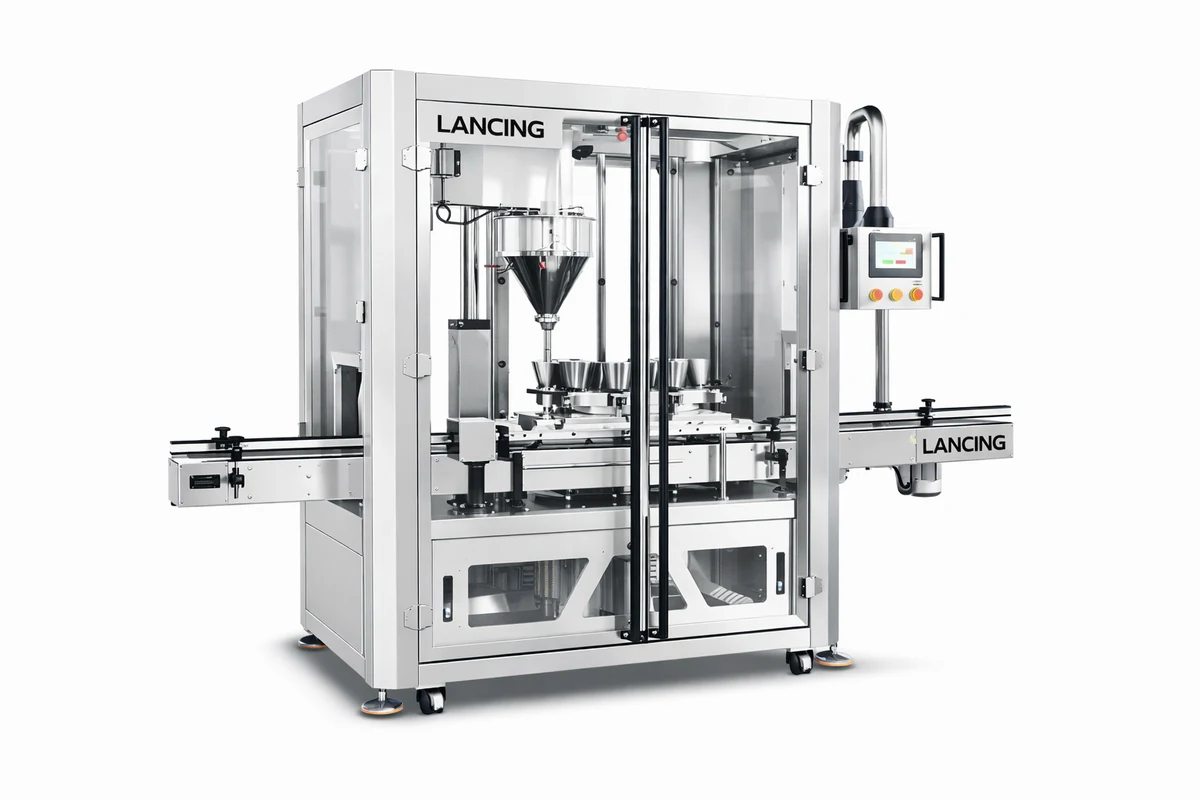
The LU-FM4A is an automatic three-head servo auger filler. Bottles are detected and positively located beneath custom nozzles, the programmed auger movement is dispensed and the filled containers are released to the next line stage.
The figures below describe a documented three-head line configuration. Final tooling, rate, repeatability, guards and interfaces are released only after sample approval and factory trials.
| Item | Documented basis | Condition to confirm |
|---|---|---|
| Dosing technology | Three-head servo-controlled auger powder filling. | Each screw/nozzle set is engineered for the powder, target and bottle opening. |
| Standard filling range | 50–300 g in the documented model basis. | A quoted 50 g application used customised dosing components; other products require separate review. |
| Hoppers | Three hoppers with agitation or conditioning selected after product testing. | Confirm refill method, powder presentation and level-control strategy. |
| Controls | Industrial PLC, colour HMI, servo drives, bottle sensing, alarms, manual jog and downstream interlocks. | Final component makes and line interface are build-specific. |
| Approximate size | 2800 mm L × 1050 mm W × 2300 mm H. | Allow additional conveyor, guarding, access, extraction and service space. |
| Approximate weight | 600 kg net / 905 kg packed. | Confirm final build, unloading and installation plan. |
| Line-rate evidence | A documented integrated-line basis used 25–35 bottles/minute. | This was an application-specific planning range, subject to the approved powder, bottle, tolerance and FAT; it is not a universal guarantee. |
| Accuracy evidence | No universal accuracy figure is published for the model page. | Set the acceptance limit and sampling plan, then prove it during sample trials and FAT. |
Containers enter in the correct orientation and spacing.
Guides and sensors stabilise the approved container beneath the nozzles.
No-bottle/no-fill logic verifies the indexed set before dosing.
Three servo augers meter the programmed quantity in parallel.
Required product settling and dust clearance occur before release.
Filled containers move to capping, sealing, inspection or labelling.
Ready, fault and emergency-stop signals coordinate the supplied line.
Use sufficient powder, bottles and downstream components to demonstrate stable filling, start/restart behaviour, hopper replenishment, container recovery, consecutive fill weights and transfer to the next machine. Record settings and exceptions rather than relying on a short demonstration.
See the sample-trial and FAT guide.
Confirm access, floor loading, electricity, compressed air where required, extraction, guarding boundaries, control handshakes and safe maintenance space. Plan the finished line rather than locating the filler in isolation.
The LU-FM4A route is appropriate where container indexing, output and integration justify an automatic line. A semi-automatic filler may remain the better choice for frequent changes, irregular packs or smaller campaigns. Compare the LU-FM750F and LU-FM710 before fixing the automation level.
Send the product, bottle, target weight, output requirement and downstream process so Lancing can review the automatic configuration.