Characterise the powder
Record bulk density, flow, dust, moisture sensitivity, particle size and any tendency to aerate or settle.
A compact semi-automatic powder filler for product development, pilot batches and lower-volume production into operator-presented bottles, jars, tubs or supported pouches.
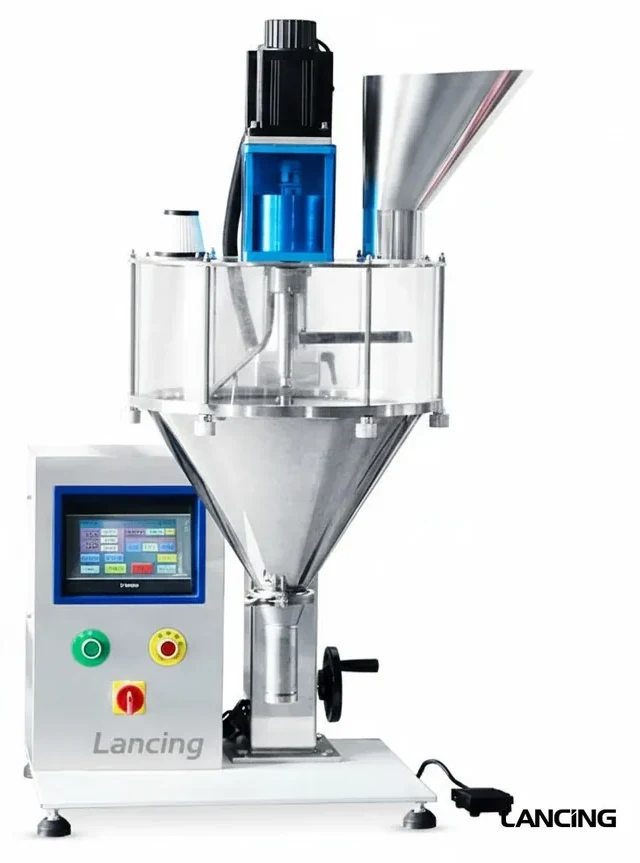
The LU-FM100B is a semi-automatic tabletop or bench-format auger filler. An operator loads the hopper, selects the approved touchscreen recipe, presents the pack beneath the nozzle and starts each dose with the foot pedal. Filled packs move to a separate closing or sealing operation.
The figures below are documented reference values, not universal production guarantees. Powder behaviour, tooling, pack opening, operator method and the agreed trial determine the final specification.
| Item | Documented reference | What must be confirmed |
|---|---|---|
| Machine type | Semi-automatic tabletop volumetric auger powder filler with operator-presented packs. | Confirm that the intended workstation, support and manual handling method suit the pack range. |
| Reference filling range | 0.5–2000 g across published tooling windows. | The practical range for one auger set is narrower and depends on product bulk density, fill volume and nozzle geometry. |
| Published tooling windows | 0.5–10 g; 2–15 g; 10–30 g; 20–50 g; 30–100 g; 100–500 g; and 200–2000 g. | Overlapping ranges do not remove the need to trial the preferred auger, tube and recipe at each target weight. |
| Hopper | Nominal 35 litres, approximately 450 mm diameter, with internal agitation. | Confirm agitation, working level and refill method for the powder's flow, aeration and bridging tendency. |
| Reference capacity | 10–25 fill cycles per minute. | Finished-pack output depends on dose, powder, operator presentation, weighing checks and the separate closing process. |
| Accuracy basis | Reference ±1% for the selected range. | Final repeatability must be established with representative product, the approved tooling and an agreed measurement method. |
| Pack envelope | Approved packs below 300 mm high in the documented arrangement. | Provide the tallest and shortest pack plus the smallest opening and intended support method. |
| Utilities | 220 V, 50–60 Hz single-phase reference configuration; standard model does not require compressed air. | A customised free-flowing-powder configuration may require an external air supply; confirm the final machine plate before installation. |
| Approximate machine size | 780 × 750 × 1150 mm; approximately 120 kg. | Allow separate space for operator movement, powder loading, cleaning, scale checks and pack closing. |
Record bulk density, flow, dust, moisture sensitivity, particle size and any tendency to aerate or settle.
Match the auger, filling tube and nozzle to the target dose volume and the smallest pack opening.
Trial auger speed, revolutions and cut-off settings with the hopper at a controlled working level.
Position the approved bottle, jar, tub or supported pouch at the agreed filling height.
Weigh fills using the agreed scale and sampling method; record start-up, stable running and refill events.
Transfer the pack to the separate capper or sealer and confirm that powder has not contaminated the rim or seal area.
The LU-FM100B suits product development, pilot production, short campaigns and lower-volume work where an operator can present each pack and perform routine weight checks. It can cover several approved products or dose windows through recipe and tooling changes, but each combination needs its own controlled setup.
It is not an automatic bottle indexer, premade-pouch feeder, checkweigher or pack-closing system. Compare the smaller LU-FM100S compact auger filler, the weigh-assisted LU-FM710, or the automatic auger filler range when the production method changes.
A catalogue range cannot prove that one auger will cover every target. The trial should retain first fills, steady-state results, hopper refills, planned pauses and the first fills after restart. It should also confirm whether the product bridges, floods, leaves a tail at cut-off or contaminates the pack rim.
Use the powder sample trial and FAT guide, the cleaning and changeover guide and the output and capacity planning guide to define the evidence.
One LU-FM100B can support several approved target weights when the required dose volumes sit within suitable tooling windows, but one auger set should not be assumed to cover the whole 0.5–2000 g reference range. Each product, target and pack opening needs a trialled tooling and recipe decision.
Direct link to answerThe documented LU-FM100B is a volumetric auger filler rather than an in-line checkweigher. Fill weights are verified using the agreed external weighing method and sampling plan. Where integrated weight-assisted operation is required, the LU-FM710 may be the more appropriate route.
Direct link to answerThe LU-FM100B can be configured for operator-presented bottles, jars, tubs or supported pouches below the documented height limit, subject to stability and opening size. Actual packs are required because a narrow neck, flexible pouch or unstable base can change the nozzle and support arrangement.
Direct link to answerPractical output is controlled by the dose time, powder flow, settling, operator presentation, weighing checks, hopper refills and the separate closing operation. The reference fill-cycle range is not the same as accepted finished packs per minute, so the complete manual cycle should be measured during trials.
Direct link to answerMove beyond the LU-FM100B when hopper replenishment, manual pack presentation, weight checking or closing prevents the required sustained output, or when an indexed line is needed. The decision should use measured cycle data and labour tasks rather than the filling-head speed alone.
Direct link to answerLancing can confirm the appropriate auger set, nozzle, hopper arrangement, trial scope and whether a compact tabletop machine is the right production route.