Measure where the powder goes before reducing the fill setting.
Powder filling giveaway is extra product delivered in accepted packs above the declared quantity. It differs from powder left in the hopper, spilled at the outlet, captured by extraction or held in rejected packs. Reduce these losses by measuring them separately, stabilising the dosing process and confirming pack acceptance before changing the operating target.
A low material cost per fill cycle is not the same as a low cost per accepted pack. This guide is a practical reconciliation method for an auger filling project; it is not a savings guarantee, a price quotation or a substitute for the packer’s quantity-control responsibilities.
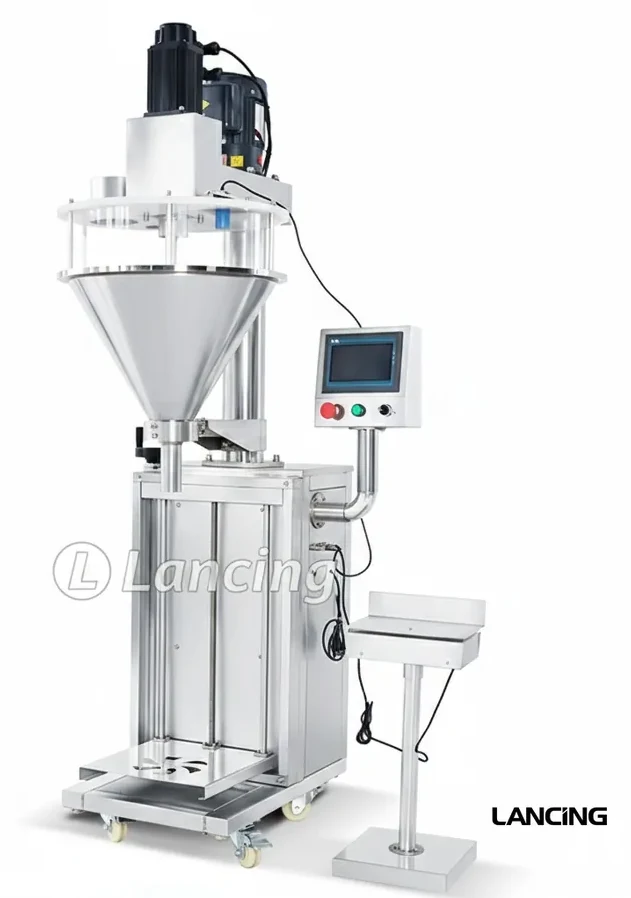
Auger filler with hopper, touchscreen and a separate pedestal weighing platform.
Separate the measurement point from the loss record.
Weight-assisted filling can be reviewed alongside product feed, pack presentation and operator tasks. The image shows an existing Lancing filling arrangement, not a measured saving or a guarantee of an included control option.
Keep categories separate
Distinguish overfill, retained product and rejected production.
Powder filling yield and loss categories
Category
How to record it
What the result helps decide
Extra product in accepted packs
Measure net weights using an appropriate tare method and compare the accepted-pack mean with the declared quantity.
Whether the operating target is higher than the stable process needs; do not use an average to disregard underfilled packs.
Start-up and setting checks
Identify product used for setup, first-off checks and recipe changes instead of mixing it into normal-run results.
Whether repeatable setup, recipe control or better change-part identification deserves attention.
Spill, dust and extraction capture
Record recoverable and non-recoverable material separately under the site’s quality and safety procedures.
Account for material remaining in the feeder, hopper, auger, transfer hose and other product-contact locations.
How batch size, access and changeover design affect recovery and cleaning.
Rejected or held packs
Record pack count, reason, powder mass where measurable and authorised rework or disposal.
Whether weight, seal contamination, labelling, damage or another downstream problem drives the loss.
Calculation
Use a transparent mass balance and avoid double counting.
Estimated extra product in accepted packs (kg) = accepted-pack count × (representative mean net weight − declared weight in grams) ÷ 1,000. This estimate applies when the mean is above the declared weight and representative of those packs. A negative result is an acceptance warning, not a material saving.
For different pack sizes or products, calculate each run separately before adding the masses. Keep the sample method and weighing uncertainty with the result. Multiply extra kilograms by the relevant product cost per kilogram only when that cost is known; use the same cost basis before and after a change.
Reconciliation difference = total powder issued − all accounted powder. Accounted powder includes the actual contents of accepted packs, authorised recovered stock, residual work in progress, rejected or held product, samples, and measured waste. Use matching start/end boundaries and count each quantity once. An unexplained difference may reflect measurement or inventory error; it is not automatically a filler loss.
This arithmetic is a planning aid. Confirm the quantity-control system and record requirements against GOV.UK guidance for packaged goods. Savings do not justify releasing non-compliant packs.
Improve in the right order
Reduce variation before relying on a lower setpoint.
Verify measurement. Confirm the scale status, units, tare method and which pack components are present at the weighing point.
Find event-related changes. Separate steady production from hopper refill, a low level, a pause and restart. Keep head-specific records on multi-head machines.
Address the physical cause. Review powder feed, tooling condition, outlet cut-off and pack positioning before compensating with an extra dose.
Test the proposed control change. Recheck the distribution, individual pack acceptance, rejects and downstream closure quality under the same conditions.
Compare the complete run. Include normal checks, residues, changeovers and accepted-pack output, not only a short sequence of ideal fills.
Where an agreed control interface exists, checkweigher feedback can adjust a filler against a measured trend. It is not included automatically on every auger filler and it does not replace stable powder flow. Specify the averaging method, adjustment limits, delay between dosing and weighing, head identification and treatment of rejected or manually removed packs.
A feedback loop should not react indiscriminately to every irregular pack. Challenge wrong tare, a missing pack, a stopped conveyor, an interrupted weighing signal and restart during acceptance testing. The designer should define a controlled response rather than allowing repeated compensation for an unresolved fault. METTLER TOLEDO’s feedback-control explanation describes the general relationship between measured mean weight and filler adjustment; the actual Lancing project needs its own agreed interface.
Use checkweighing after auger filling for the inspection and reject specification. This page addresses how that evidence supports material-use decisions, not the choice of a standalone checkweigher.
Buyer questions
Questions about giveaway and powder yield.
Can I reduce powder giveaway simply by lowering the target?
Lowering the target does not remove process variation. It can create more underfilled packs if the original excess was masking unstable dosing. Verify the measurement method, identify the source of variation and prove individual pack acceptance before approving a lower operating target.
Should extraction be reduced when powder appears in the collector?
Do not reduce a safety control simply to improve yield. Capture may be controlling a real exposure or fire risk. Have the fill point, product escape and extraction arrangement reviewed together by competent people, then validate any change through the relevant safety and product-quality procedures.
Why can batch yield be poor when every checked pack weighs correctly?
Correct pack weights do not account for powder retained in equipment, setup samples, spills, rejected closures or stock held for rework. Reconcile the issued product against all destinations using one batch boundary. This separates a dosing issue from handling, cleaning or downstream losses.
How should buyers compare two auger fillers on product use?
Compare equivalent products, packs, acceptance rules and measured production periods. Record accepted output, net-weight distribution, refills, interventions, start-up use, residues and rejects. A comparison based only on the purchase price or the fastest dose cycle can miss the costs that dominate frequent small batches.
Quotation evidence
Prepare a material-use review with your enquiry.
Send the powder, pack, target quantity, observed net-weight range and current production sequence. Include batch size, changeover frequency, refill method, known loss locations and how rejects are managed. Existing records can be anonymised. Where no measurements exist, describe the problem honestly so a trial can collect the missing evidence rather than inventing a return on investment.